Search "penile implant" online and you'll surface two completely different categories of medical device, used for two completely different purposes, in two completely different patient populations. The confusion is so widespread that men routinely arrive at our consultations under the impression these are interchangeable terms. They are not. Understanding the distinction is the first step toward choosing the right procedure — or recognizing that you may not need a procedure at all.
From Dr. Robbins' PracticeThis article exists because almost every week, a new patient arrives at my consultation room with this exact confusion. I want to draw the distinction clearly because the misunderstanding has real consequences — wasted consultations, unrealistic expectations, and sometimes regret about a choice that could have been better informed.
The Two Categories at a Glance
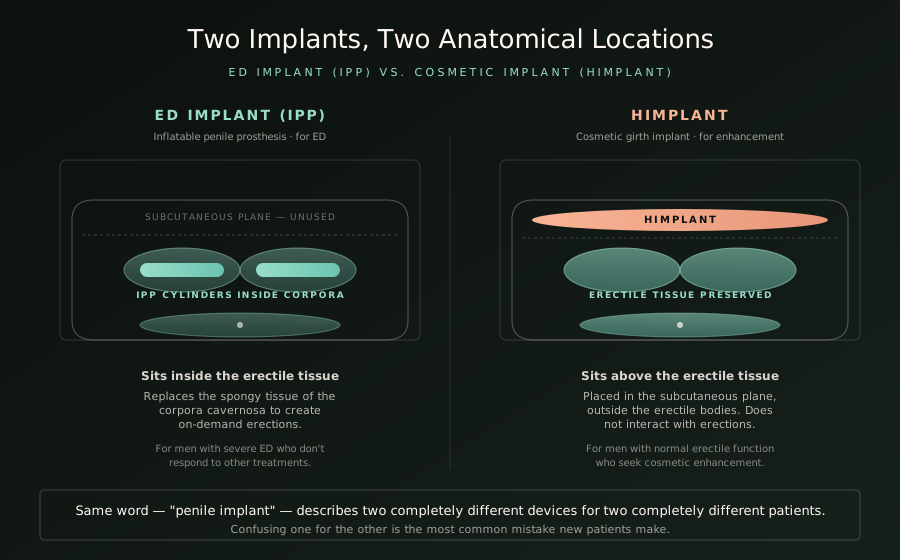
ED implants — technically known as inflatable penile prostheses (IPP) or malleable rod prostheses — are devices placed inside the corpora cavernosa (the two erectile chambers within the penis) to mechanically restore the ability to achieve a rigid erection in men whose natural erectile function cannot be salvaged through medication or other therapies. They are a treatment for severe erectile dysfunction.
Cosmetic implants — of which the Himplant is the only FDA-cleared example — are soft silicone devices placed beneath the penile skin (subcutaneous), wrapping around the outside of the erectile chambers without entering them. They are designed to increase girth and flaccid length for cosmetic reasons. They do not treat erectile dysfunction and do not affect the internal erectile mechanism.
In plain terms: one fixes function. The other changes appearance. They live in different anatomical layers and serve different patients.
ED Implants (Inflatable Penile Prosthesis)
What They Are
An IPP consists of two inflatable cylinders implanted inside the corpora cavernosa, a small reservoir of saline placed in the lower abdomen, and a pump positioned within the scrotum. Squeezing the pump moves fluid from the reservoir into the cylinders, producing rigidity. A release valve returns the device to flaccid state. The components are connected by tubing routed through internal tissue planes.
Who They're For
IPPs are reserved for men with severe erectile dysfunction who have failed less invasive treatments, including PDE5 inhibitors (Viagra, Cialis), penile injections, vacuum devices, shockwave therapy, and other regenerative approaches. Common candidacy reasons include post-prostatectomy ED, severe vascular disease, advanced diabetic ED, and Peyronie's disease with associated functional loss.
What They Change
An IPP allows the patient to produce a rigid erection on demand. It does not increase the size of the penis in any meaningful way — in fact, some men experience a slight reduction in perceived length due to scar tissue contraction within the corpora. The procedure is performed for function, not aesthetics.
Trade-offs
IPP placement is a more invasive procedure. The internal erectile tissue is permanently altered — once the natural spongy tissue of the corpora cavernosa is removed or compressed to make room for the implant, it cannot be restored. If the IPP later fails or is removed, the patient is dependent on the device for any future erection. Mechanical failure, infection risk (low but real), and revision surgery rates over time are realistic considerations.
Cosmetic Implants (Himplant)
What They Are
The Himplant is a soft, biocompatible silicone implant placed in a surgically created pocket between the penile skin and the underlying tissue. The device wraps approximately 270 degrees around the shaft, delivering a uniform increase in circumference. It does not enter the corpora cavernosa or interact with the internal erectile mechanism in any way.
Who They're For
Himplant candidates are men with normal erectile function who desire a long-lasting cosmetic increase in penile girth and flaccid length. These are men who do not need treatment — they are seeking enhancement. Many have considered or used hyaluronic acid filler-based enhancement and want a result that does not require periodic re-injection.
What They Change
The Himplant delivers a meaningful, lasting increase in girth and flaccid length. Based on past studies, erectile function, sensation, orgasm, and urination are unaffected. The implant sits beneath the skin and does not interfere with the internal structures of the penis. Typically, the result looks and feels organic to both the patient and partner.
Trade-offs
The Himplant is a single outpatient procedure with a defined recovery window (6–8 weeks before resuming sexual activity). It is not appropriate for men with previous penile surgery, severe scar tissue, or significant anatomical abnormalities. Results vary based on individual anatomy, skin elasticity, and healing response. The Himplant device is backed by a manufacturer limited lifetime warranty; terms and conditions apply.
Side-by-Side Comparison
Purpose: IPP restores erectile function. Himplant increases girth and flaccid length for cosmetic reasons.
Anatomical placement: IPP is placed inside the corpora cavernosa (deep). Himplant is placed beneath the penile skin (superficial).
Effect on natural erection: IPP replaces the natural erectile mechanism. Himplant preserves it entirely.
Mechanical activation: IPP requires pumping a scrotal device to activate. Himplant requires no activation — it is always present.
Patient profile: IPP is for men with severe ED who have failed other treatments. Himplant is for men with normal function seeking cosmetic enhancement.
Reversibility: IPP causes long-lasting changes to internal erectile tissue. Himplant can be removed without affecting underlying anatomy.
Surgical time: IPP typically takes 60–90 minutes. Himplant placement generally takes approximately 45–90 minutes.
Sensation: IPP may slightly alter sensation. Himplant preserves sensation, based on past studies.
Why the Confusion Exists
The English language is partly to blame. Both procedures involve a device placed inside the body, both are called "penile implants" in casual usage, and both are performed by urologists. But within urology, these are entirely separate procedural categories with separate training, separate device manufacturers, and separate patient pathways.
The internet does not help. Search engines often blend results from both categories under generic "penile implant" queries, and forum discussions frequently mix terminology. Even some healthcare websites do not clearly distinguish the two. The result is a population of men — sometimes with severe ED, sometimes with normal function and aesthetic concerns — who arrive at consultations with hybrid expectations from both categories.
Which One Might Apply to You?
A few practical orienting questions:
Are you having difficulty achieving or maintaining erections despite trying medication or other treatments? If yes, your situation involves erectile dysfunction. The IPP category is what's relevant — though many men in this situation can avoid surgery entirely through shockwave therapy, PRP, exosome therapy, or other regenerative options.
Are your erections normal but you're seeking a cosmetic increase in size? If yes, the Himplant or non-surgical HA filler-based enhancement are the relevant options. An IPP would be entirely inappropriate — it doesn't address aesthetics, and it would permanently alter functional anatomy you don't need to change.
Do you have both ED and aesthetic goals? This is more complex. The two procedures are not mutually exclusive, but they are not typically performed simultaneously, and the treatment sequence requires careful planning. A consultation is essential.
A Note on Other "Enhancement" Procedures
Beyond the IPP and Himplant categories, you may encounter mentions of fat transfer, dermal grafts, ligament release, and various injectable techniques. Each has its own profile of effectiveness, durability, complication rates, and candidacy criteria. The Himplant occupies a specific niche — FDA-cleared, lasting, with a well-defined safety profile — that distinguishes it from these alternatives.
The Bottom Line
If you have heard the phrase "penile implant" used in a context that confused you, you are not alone. ED implants and cosmetic implants are completely different devices for completely different purposes. Knowing which category your situation falls into — or whether either applies — is the foundation of a productive consultation.
At INTIMÉ Miami, Dr. David Robbins is one of a select number of urologists in the United States trained and authorized to perform the Himplant procedure, having completed his training directly with Dr. James Elist, the device's inventor. Schedule a confidential consultation to discuss whether the Himplant is right for you.
Written by Dr. David Robbins — Board-Certified Urologist and Medical Director of INTIMÉ Miami.